How KP built a personal brand by building in public

By Maya · · 5 min read
The guest
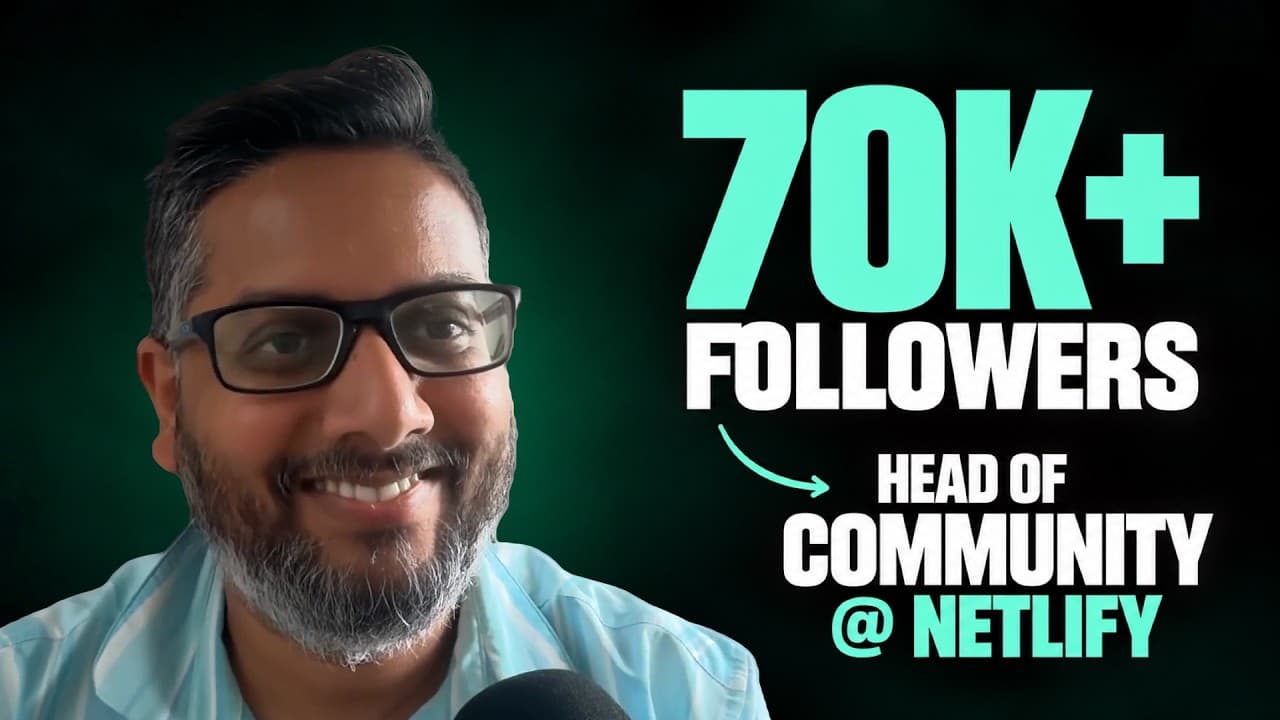
KP
Head of Community, Netlify
70K+followers
Build in public · Personal brand
How do you build a personal brand by building in public?
KP says a personal brand forms when you pick an idea you care about enough to keep exploring, and keep publishing about it for years. He has talked about building in public since 2018, recorded 96 podcast episodes, and built about 15 no code projects publicly in 2020. Roles at On Deck, Paddle, and Netlify came from people finding that record.
Key moments
- 0:00Intro
- 1:00How KP became "the build in public guy"
- 4:01Why the big rewards come late
- 5:57X serendipity and landing the Netlify job
- 8:28Why X feels fun again
- 11:5610,000 hours: everyone underestimates the reps
- 12:59How to build in public when cloning is easy
- 17:41The best products take a thousand iterations
- 18:53Wrap up
KP became Netlify's head of community and one of the more recognizable build-in-public voices without a strategy for either outcome. He found an idea he cared about, kept talking about it, and let the accumulated record do most of the work.
How a personal brand actually forms
KP traces his association with building in public to 2018. By the time he joined Netlify, people across On Deck, his wider network, and Twitter already connected his name to that idea. He had spent roughly eight years discussing it seriously, not because he had selected the most fashionable phrase.
He explored other interests along the way: no-code tools, philosophy, adjacent ideas. Building in public became the strongest signal because he kept returning to it and other people kept responding.
His framing is worth taking literally: choosing an idea you care about enough to keep investigating is different from selecting a slogan. The slogan runs out of momentum. The genuine interest keeps producing material.
Why early results feel wrong, and why they're normal
He remembers producing 96 podcast episodes. The first 18 felt painful. His audience at that point was around 11 to 20 listeners, and the effort did not seem to justify itself.
He kept going because he valued the work and the repetitions, not the return. His first-90% / last-10% formulation, where most of the visible reward arrives late, is motivational shorthand, not a measured growth curve. The useful part of it is the underlying observation: early public work is almost always unrewarding by external measures, and that's not a signal to stop.
He compares it to someone walking into a gym and seeing a finished physique. The difficult early years aren't visible. The beginner misreads the evidence and sets the wrong expectations.
When Maya describes herself as impatient, he normalizes that stage without dismissing it. He says patience improved in his thirties, not because he became a different person, but because he learned that frustration with the pace wasn't a useful strategy.
How public work creates career opportunities
He describes his career as a sequence of connections that public activity made possible rather than a plan he executed.
The CMO at Paddle encountered him on Twitter before any formal conversation. His Netlify opportunity preceded his move from Atlanta, where he was living at the time. These weren't cold applications. People found his work, formed a view of him through it, and reached out.
In 2020, he built roughly 15 no-code projects publicly. People at On Deck watched a working practitioner produce useful material repeatedly, then approached him for a program-director role. He remembers receiving a document explaining why he was the right fit. He didn't have to construct the entire case himself from scratch. By that point, he estimates he had published hundreds of related tweets.
The mechanism isn't mysterious. Visible evidence of what you care about, repeated often enough, creates the conditions for people with overlapping interests to find you. Public work is a surface area problem.
How he thinks about writing on X
He finds Twitter/X more conducive to unpolished thinking than LinkedIn, where a visible résumé and a professional network watching can pressure people to perform a polished identity rather than share what they're actually working through.
His approach is to treat X as a place to talk with friends and potential friends. The writing has become more relaxed over time. His practical point is to sound like yourself talking to another person, rather than making every post read like a credential.
He also describes learning in public without overstating expertise. When he was learning Bubble, Airtable, and Webflow, he shared what he was discovering rather than positioning himself as an advanced practitioner. The principle transfers: explain what you've learned so far without claiming to be the authority. Someone searching for answers may find a useful post without ever engaging with it. Silent readers are still an audience, still forming impressions.
Why one post is not a test of anything
He contrasts how school works with how public work works. In school, one assignment produces a grade. A single post or episode is not enough evidence of whether the channel can work. Repetition develops the skill and gives discovery more chances.
His 100 repetitions formulation is motivational shorthand, not a guaranteed threshold. It captures that successful people had accumulated far more practice than was visible to people encountering them for the first time. He wishes he had understood that earlier.
The practical implication is that quitting on thin evidence is a common mistake. A handful of posts is not a basis for concluding the format doesn't work, the audience isn't there, or the idea isn't worth developing.
On competition and what copying can't reproduce
He thinks faster cloning has changed the speed of competition, not the fundamental case for building in public. His rough illustration (what took a week now takes an hour) is directionally accurate enough to be useful without being precise.
He uses social scheduling tools as an example of successful products that attracted imitators. His response to competition is to welcome it as pressure to improve. A copying team, in his view, is by definition reactive. They are responding to what the original team builds. His sports analogies express a competitive posture rather than prove every clone loses.
The more substantive point is about where early founders put their attention. Answering support tickets, joining setup calls, helping customers succeed with the product: these things accumulate into relationships that are harder to copy than a landing page or a feature set.
He gives a specific example: a founder with ten paying customers should regularly give one of them a genuine public shout-out and help that customer get business. The expected return is gratitude and loyalty. This is proposed behavior, not a measured retention result, but the underlying logic holds. A competitor can copy a product page more easily than the accumulated conversations and personal help that create trust.
His own reaction to being copied
He remembers feeling angry and discouraged when an early product was closely imitated. After building many more things, he became less preoccupied with clones, though he doesn't pretend direct copying stops stinging entirely.
His frame for a founder with 20 hours a week: put that attention into delivering more value to customers, not monitoring what competitors are doing with your work. A product embodies successive iterations and the decisions behind them. Copying one version misses all of that. His suggested responses are to move on or, occasionally, respond with humor, not to dwell on it.
What the pattern adds up to
KP didn't plan his way to a personal brand associated with building in public. He chose an idea he wanted to keep exploring, kept producing public output around it, did actual work that gave him specific things to teach, and let the record accumulate.
The opportunities that followed, Paddle, On Deck, Netlify, came from people encountering that record and drawing their own conclusions. He didn't pitch himself into those roles. The public work made the pitch partially unnecessary.
That's the pattern across eight years and 96 podcast episodes. Most of it felt slow while it was happening.
Questions this talk answers
How long does it take to see results from posting publicly?
Longer than it feels like it should. KP's first 18 podcast episodes felt painful, with around 11 to 20 listeners. He says one post is not a test of anything and frames it as roughly 100 repetitions, because most of the visible reward arrives late.
What should you do when someone copies your product?
KP's advice for a founder with 20 hours a week is to spend that attention on delivering more value to customers, not on watching competitors. A copying team is reactive by definition. Customer relationships, support, and personal help are harder to copy than a landing page.
Is X or LinkedIn better for building in public?
KP finds X more conducive to unpolished thinking. On LinkedIn, a visible résumé and a professional network can push people to perform a polished identity. His approach is to treat X as a place to talk with friends and potential friends, and to sound like yourself.
Where will your first 10 customers come from?
Answer 5 quick questions. Get the one channel to start with and a 7-day plan from a founder who did it.
Find my channel


Builders tune in weekly.